
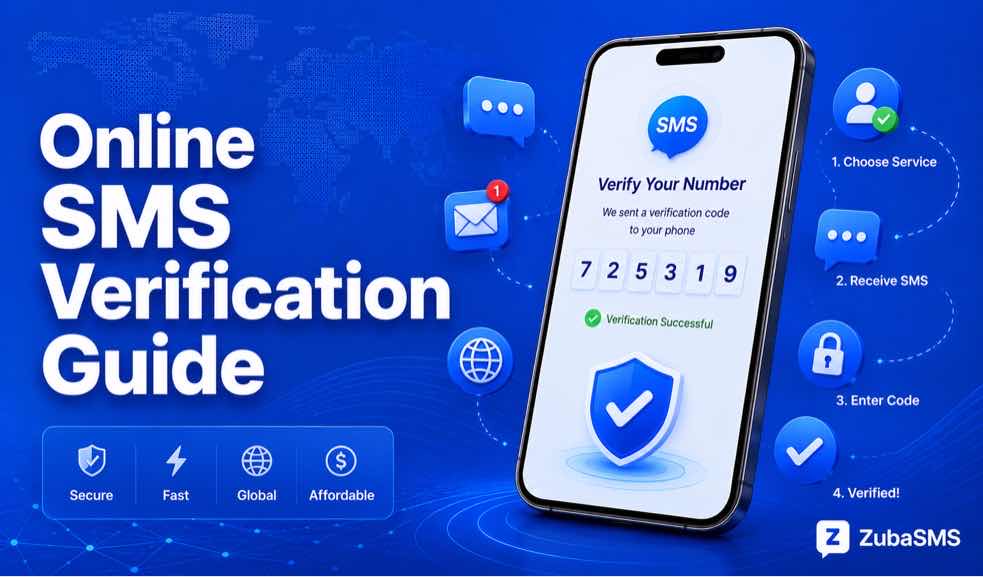
What Is SMS Verification? Complete Beginner’s Guide
What Is SMS Verification?
As more services move online, protecting user accounts has become increasingly important. One of the most widely used methods for confirming user identity is SMS verification. From social media platforms to banking applications and online marketplaces, SMS verification helps confirm that the person creating or accessing an account has control over a valid phone number.
Although the process usually takes only a few seconds, it plays an important role in improving account security and reducing fraudulent registrations.
This guide explains what SMS verification is, how it works, where it is commonly used, and why many online platforms continue to rely on it.
Table of Contents
- What Is SMS Verification?
- How SMS Verification Works
- Why SMS Verification Is Important
- Common Uses
- What Is an OTP?
- Typical Verification Process
- Types of Phone Numbers
- Benefits of SMS Verification
- Limitations
- Security Best Practices
- Using ZubaSMS
- Frequently Asked Questions
- Conclusion
What Is SMS Verification?
SMS verification is a security process that confirms ownership of a phone number by sending a one-time password (OTP) through a text message. The user enters the received verification code into the website or application to complete authentication.
Verification codes are usually valid for only a short period and are intended for one-time use.
How SMS Verification Works
The verification process typically follows these simple steps:
- The user enters a phone number.
- The platform generates a one-time verification code.
- The OTP is sent through SMS.
- The user receives the message.
- The verification code is entered.
- The platform validates the code.
- The account is verified.
In many situations, the entire process is completed within seconds.
Why SMS Verification Is Important
Identity Confirmation
SMS verification confirms that the user has access to the submitted phone number.
Account Protection
Verification helps reduce unauthorized account creation and improves overall security.
Password Recovery
Many online services send verification codes when users request password resets.
Reduce Automated Registrations
Requiring phone verification helps reduce spam accounts created by automated systems.
Common Uses
SMS verification is widely used across many industries.
- Social media platforms
- Messaging applications
- Email services
- Financial institutions
- Cloud platforms
- Business applications
- Online marketplaces
- Password recovery
What Is an OTP?
An OTP (One-Time Password) is a temporary security code generated specifically for a single verification session.
Unlike permanent passwords, OTPs:
- Expire after a short period
- Can only be used once
- Improve account security
- Help confirm user identity
Typical Verification Process
| Step | Description |
|---|---|
| 1 | Enter phone number |
| 2 | Receive OTP via SMS |
| 3 | Enter verification code |
| 4 | Verification completed |
Types of Phone Numbers Used
SMS verification may use different phone number types depending on the platform.
- Personal mobile numbers
- Business phone numbers
- Virtual phone numbers
- Temporary numbers
- Rental numbers
The verification platform determines which number types are accepted.
Benefits of SMS Verification
Fast Verification
Verification codes are often delivered within seconds.
Improved Security
OTP verification provides an additional layer of account protection.
Simple User Experience
Most users are already familiar with receiving SMS messages, making verification straightforward.
Limitations
Although SMS verification is widely used, it is not without limitations.
Network Delays
Verification messages may occasionally arrive later than expected because of carrier routing, network congestion, or temporary infrastructure issues.
Expired Verification Codes
Most one-time passwords remain valid for only a short period. Once expired, a new verification request is required.
Platform Restrictions
Some online services restrict certain virtual, VoIP, temporary, or shared phone numbers. Acceptance depends entirely on each platform's verification policies.
Phone Number Availability
If users lose access to the phone number linked to an account, future verification or account recovery may become more difficult.
Security Best Practices
Never Share OTP Codes
Verification codes should remain private. Legitimate companies will never ask you to reveal your one-time password outside the intended verification process.
Enable Two-Factor Authentication
Where available, activate additional security features after completing SMS verification.
Use Trusted Providers
If using virtual numbers for supported verification, choose reputable providers with reliable SMS delivery and transparent privacy practices.
Maintain Access to Important Numbers
For long-term accounts, keeping access to your verification number helps simplify future password recovery and account security checks.
Using ZubaSMS
ZubaSMS provides temporary and rental virtual phone numbers across multiple countries for supported SMS verification and online communication, depending on current availability.
Users can review available options based on:
- Country availability
- Incoming SMS support
- Temporary or rental duration
- Privacy preferences
- Current inventory
Acceptance of any phone number depends entirely on the verification policies of the online platform requesting verification.
Funding Options
| Location | Funding Method |
|---|---|
| Nigeria | Bank Transfer |
| Ghana | Mobile Money |
| Kenya | M-Pesa |
| International | USDT |
Frequently Asked Questions
What is SMS verification?
SMS verification is a security process that confirms ownership of a phone number by sending a one-time password (OTP) through SMS.
What is an OTP?
An OTP is a one-time password that is valid for a single verification session and usually expires after a short period.
Why do websites use SMS verification?
It helps confirm user identity, reduce fake registrations, improve account security, and support password recovery.
Can virtual phone numbers receive verification codes?
Some supported virtual numbers can receive SMS verification codes, although acceptance depends entirely on the platform requesting verification.
Why didn't my verification code arrive?
Possible reasons include network delays, incorrect phone numbers, expired requests, unsupported number types, or platform-specific restrictions.
Is SMS verification secure?
SMS verification provides an additional layer of security, especially when combined with strong passwords and two-factor authentication.
Need Reliable SMS Verification?
If you're looking for temporary or rental virtual phone numbers for supported SMS verification and online communication, ZubaSMS offers virtual numbers across multiple countries, subject to availability.
Visit ZubaSMS to get started.
Conclusion
SMS verification remains one of the most widely used methods for confirming user identity online. By sending a temporary one-time password to a phone number, websites and applications can reduce fraudulent registrations while improving account security.
Understanding how SMS verification works, the role of OTPs, different phone number options, and recommended security practices helps users complete verification more confidently while protecting their online accounts.